Encouragement for Writers
I don't pretend to be an expert, but here's my advice...

Getting published is tough but not impossible. Read everything you can get your hands on. Study the market. Learn your craft. Seek honest criticism. If you have discipline, resilience and persistence... if you write what people want to read... you will be published. No matter how many times you're rejected, never stop believing in yourself and do not give up. Someone, somewhere will read your book and say, "I love it!"
Are you feeling down about a book rejection you've received?
Click here to read rejections received by some famous authors
You can even Share the Misery by submitting your own rejection!
Want some encouraging quotes?
Click the link to read encouraging quotes for writers
Need some writing advice?
Writing advice from Marilee Brothers...
And, the Plot Thickens
When I started writing Affliction, I had main characters in mind, the skeleton of a plot and a vague idea of how the book would start and end. The middle was a vast abyss of nothingness. When it comes to plotting, I usually fly by the seat of my pants. I've always trusted the process. The act of writing stimulates the creative part of my brain, resulting in forward progress. Sure, once in a while, I'd write myself into a corner and have to backtrack. But, it was usually an easy fix and I considered it a learning experience. Six chapters flew by and then my fingers froze on the keyboard. I was stuck.
Here's what happened next:
1. I brooded and indulged in a lot of negative self-talk. What the heck's wrong with you? Yikes! After eight books are you out of juice?
2. I forced myself to write. As the saying goes, you can't edit a blank page. When it took me an hour to write two sentences, I knew it wasn't working. This was followed by . . .
3. More brooding.
4. I tried writing in long hand, a technique that sometimes works for me. Not this time.
5. I comforted myself with junk food which, in turn, led me to . . .
6. The Solution. Concerned about putting on weight from the aforementioned junk food, I hit the elliptical machine at our local fitness club. Something about the music feeding directly into my brain via ear buds, mindless repetition as I sweated and pedaled, plus the oxygenated blood surging through my body did the trick.
Remember my term, "vague idea of the plot line?" I realized I was a little too vague. I was writing romantic suspense, for Pete's sake! I had a spunky little heroine named Mel. I had a sexy Harley-Davidson riding ex-Marine named Billy. I had dead bodies, nasty villains, stolen babies and human trafficking. Way too many moving parts for an author flying by the seat of her pants. I needed details. I needed more characters. I needed more plot details. OMG, was I becoming a plotter? Were my pantser days over?
Happily, I was soon back on track after taking some time to answer the obvious questions. Who? What? Why? Where? When? Part plotter, part pantser. It works for me. And, if it happens again, I know how to get through it.

Eat junk food.
Exercise.

Need more encouragement?
Click the audio player below to hear Marilee's favorite "keep your chin up" song... 222nd Wind by Kacey Jones
Visit Kacey Jones' Website... www.KaceyJones.com
Have a question or comment for Marilee Brothers?
Use this easy Contact Form
The latest from Marilee Brothers
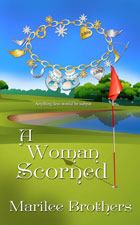
Next up:
Eve's Downfall
The sequel to
A Woman Scorned
Click here to
read an excerpt

Copyright 2007-2018 - Marilee Brothers. All rights reserved.
Website built by Jonelle Mejica, Write Mind.